

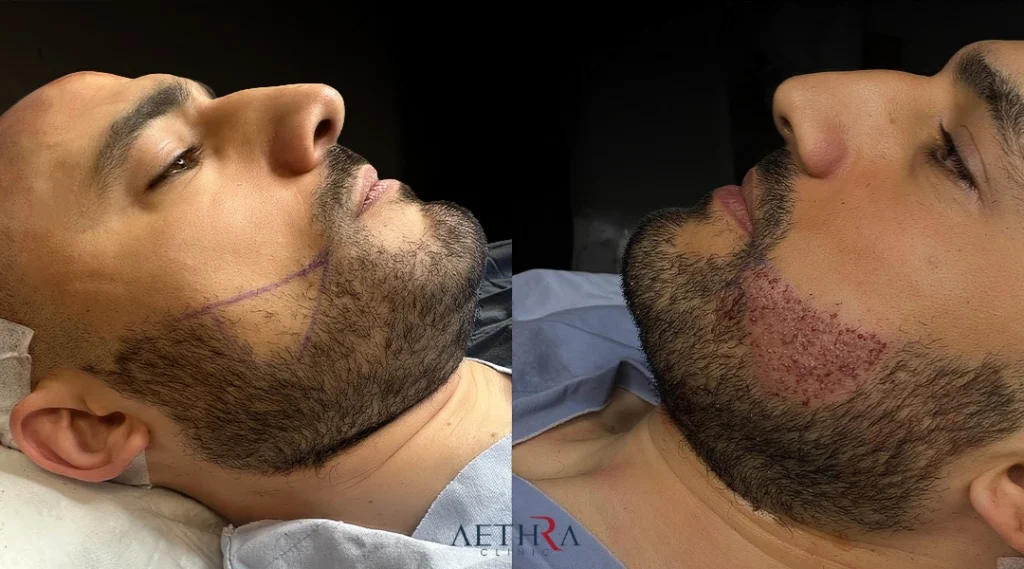
A beard transplant Turkey procedure is a medical facial hair restoration treatment designed to fill patchy, thin, uneven, or scarred beard areas using hair follicle transplantation. For many men, the goal is not only “more beard.” The real goal is a stronger jawline, better facial balance, fuller cheek coverage, a denser chin, and a beard design that looks natural from every angle.
At Aethra Clinic, beard transplant planning follows the same philosophy used in hair transplantation: careful medical evaluation, realistic planning, donor area protection, natural angle control, and doctor-led execution. Aethra Clinic is connected to the European patient journey through its Slovakia structure and performs procedures in Istanbul, Turkey, where international patients benefit from medical tourism logistics, experienced surgical planning, and a more accessible treatment model.
Unlike mass-production clinics that focus mainly on graft numbers, Aethra Clinic focuses on the quality of planning. A beard transplant is permanent. Once follicles are extracted from the donor area and implanted into the face, the result becomes part of the patient’s long-term appearance. That is why the design, graft distribution, direction, density, donor management, and aftercare system matter as much as the operation itself.
Table of Contents
Why Men Choose Beard Transplant Turkey
Men choose beard transplant in Turkey for several strong reasons. Some patients have naturally weak beard growth because of genetics. Others have patchy cheeks, gaps between the mustache and beard, weak sideburn connections, or an uneven chin area. Some patients want to cover scars caused by acne, burns, injuries, or previous skin trauma.
Turkey has become one of the most searched destinations for facial hair transplantation because it combines experienced medical teams, international patient organization, and cost advantages compared with many European countries. For patients from Slovakia and the wider Europe region, Istanbul is also highly accessible, making the full process easier to plan.
However, the most important question is not only where the procedure is performed. The real question is who plans it, who performs the critical steps, and how carefully the donor area is protected.
Aethra Clinic positions beard and hair restoration as a medical procedure, not a simple cosmetic service. Every patient should understand that transplanted grafts are limited, facial design is permanent, and poor angle placement can create an unnatural result. This is why Aethra Clinic emphasizes doctor-led evaluation, ethical candidacy assessment, natural design, and continuous follow-up.
Beard Transplant Turkey at Aethra Clinic
A beard transplant Turkey at Aethra Clinic is planned around the patient’s natural facial structure, donor capacity, beard goals, and long-term appearance. The clinic’s approach is especially relevant for men who want a natural-looking result rather than an artificial, overly dense, or “drawn-on” beard line.
Aethra Clinic’s medical philosophy is based on:
- Doctor-led planning
- Personalized beard design
- Natural angle and direction control
- Conservative donor area management
- Low-volume boutique patient care
- International patient coordination
- Post-operative follow-up
- Premium Istanbul treatment experience
Aethra Clinic uses a refined Sapphire FUE-based approach in hair restoration procedures, where sapphire blades allow precise channel creation and controlled placement direction. In facial hair restoration, this precision mindset is essential because beard hairs grow in different angles across the cheeks, jawline, chin, and mustache connection area.
How a Beard Transplant Works
A beard transplant works by transferring healthy hair follicles from the donor area, usually the back of the scalp, to the beard region. These follicles are carefully extracted and then implanted into areas where facial hair is sparse, weak, uneven, or absent.
The main medical logic is simple: donor follicles taken from the scalp can continue to grow after being transplanted into the beard area. Over time, these hairs become part of the patient’s grooming routine and can usually be trimmed, shaped, and maintained like natural facial hair.
But the technical side is not simple.
The beard area is one of the most visually sensitive zones of the face. The angle of implantation must be very low and natural. Cheek hairs, jawline hairs, chin hairs, and mustache-adjacent hairs do not all grow in the same direction. If the clinic places every graft in a uniform direction, the result can look artificial. If the density is planned incorrectly, the beard can look patchy, pluggy, or overly harsh.
This is why Aethra Clinic focuses on design before graft numbers. The aim is not simply to implant as many grafts as possible. The aim is to create a beard that belongs to the patient’s face.
Beard Transplant Turkey Steps
A beard transplant Turkey process at a professional clinic should be structured, medically controlled, and transparent from the first consultation to the final follow-up. Aethra Clinic’s general international patient journey is built around consultation, planning, procedure organization, and aftercare support, including personalized treatment planning and patient guidance
1. Online Consultation
The process usually begins with photo evaluation. The patient sends clear facial photos from different angles. The doctor evaluates beard gaps, facial structure, donor potential, skin condition, and expectations.
At this stage, the patient should explain the desired beard style clearly:
- Fuller cheeks
- Stronger jawline
- Better mustache-beard connection
- Denser chin
- Scar coverage
- Softer natural beard edges
- Sharper barber-style beard borders
Aethra Clinic does not treat beard design as a template. The plan should match the patient’s face, not another person’s photo.
2. Medical Evaluation and Candidacy
Not every patient is automatically suitable for beard transplantation. A good candidate should have enough healthy donor hair, realistic expectations, and stable facial hair concerns.
If beard loss is recent, sudden, or medically suspicious, the clinic may need to consider whether there is an underlying cause before surgery. Hair and beard restoration should never be rushed without proper evaluation.
This stage is also where ethical clinics differ from aggressive sales-based clinics. A responsible clinic does not promise unrealistic density if the donor area cannot safely support it.
3. Arrival in Istanbul and Patient Organization
International patients often prefer Turkey because the process can be organized in a clear timeline. Aethra Clinic’s patient journey includes structured planning for consultation, procedure, and aftercare, making the experience easier for patients coming from Slovakia, Germany, Norway, and other European countries.
For European patients, this organization matters because they are not only booking a medical procedure. They are traveling abroad for a permanent facial change. A smooth system reduces stress and helps the patient focus on the procedure and recovery.
4. Beard Design
The beard design stage is one of the most important parts of the entire procedure.
A natural beard is not created with one straight line. It requires understanding of:
- Face shape
- Jawline structure
- Cheek height
- Existing beard direction
- Natural density transitions
- Mustache connection
- Chin strength
- Sideburn balance
- Patient’s grooming style
Some patients want a sharp, masculine, well-defined beard line. Others want a softer and more natural look. Both can be correct, but both require different planning.
At Aethra Clinic, the design philosophy should support facial harmony. A strong beard should improve the patient’s appearance without looking artificial.
5. Local Anesthesia
The procedure is performed under local anesthesia. The donor area and recipient beard area are numbed so the patient can remain comfortable during the procedure.
Most patients describe the process as manageable. There may be pressure or mild discomfort, but the main surgical stages should not be painful when anesthesia is properly applied.
6. Graft Extraction
Healthy follicles are extracted from the donor area, usually the back of the scalp. The donor area is limited and must be protected carefully.
This is one of the most important points patients often underestimate. A beard transplant uses donor hair that may also be needed for future hair transplant planning. If a clinic overharvests the donor area, it can create visible thinning or reduce future options.
Aethra Clinic’s long-term planning philosophy is especially important here. The goal is not to “use the donor area aggressively.” The goal is to use it intelligently.
7. Channel Opening and Implantation
This is where natural results are created or lost.
The recipient channels must be opened according to the correct angle, direction, and density. Beard hair usually sits flatter against the skin than scalp hair. The direction changes subtly across the face. For example, cheek hair may flow differently from jawline hair, while chin hair may require stronger density and different direction planning.
Aethra Clinic’s Sapphire FUE philosophy is built around precision in channel creation, natural-looking placement, and controlled direction. Sapphire blades are used in hair restoration to create smaller and more accurate recipient channels, supporting natural density and recovery.
For beard transplantation, this precision-based approach is essential because even small angle mistakes can be visible on the face.
8. Aftercare and First Wash Guidance
After the procedure, the clinic provides aftercare instructions. The patient must avoid rubbing, scratching, sweating heavily, or using harsh products during the early healing phase.
The beard area may show redness, small scabs, mild swelling, and sensitivity. These are common in the first days. The patient must follow the clinic’s instructions carefully because the early days are important for graft protection.
Aethra Clinic emphasizes structured follow-up and patient guidance, which is especially valuable for international patients returning to Slovakia or another European country after the procedure.
Why Sapphire FUE Precision Matters in Beard Transplant
Aethra Clinic’s hair restoration identity is strongly connected with Sapphire FUE, a technique that uses sapphire blades during recipient channel creation. In hair transplantation, Sapphire FUE supports precise incisions, controlled angles, dense placement, and natural-looking outcomes.
For beard transplant planning, the same precision logic is critical.
A beard does not grow like scalp hair. Facial hair has different angles, directions, and density zones. The cheeks need softer transitions. The jawline may need stronger definition. The chin may require denser placement. The mustache connection must be handled carefully so it does not look forced.
Poorly planned beard transplants can look fake because of:
- Hairs placed too upright
- Unnatural straight beard borders
- Excessive density in the cheek area
- Wrong direction around the jawline
- Pluggy appearance
- Poor donor hair selection
- Lack of facial design planning
Aethra Clinic’s doctor-led, low-volume approach is designed to avoid these mistakes by focusing on long-term natural appearance rather than fast, high-volume procedures.
The Design Step
The design step is where a beard transplant in Turkey succeeds or fails.
A strong beard transplant design should not copy another man’s beard. It should respect the patient’s own face.
For example, a very sharp beard line may look good on one face but artificial on another. A dense cheek design may suit one patient but make another face look heavy or unnatural. Some men need only scar correction or patch filling. Others need full beard reconstruction.
Aethra Clinic’s boutique model is important because facial design requires time. The doctor must evaluate the patient’s anatomy, not just sell a package. A mass-clinic approach can be risky because beard transplantation is too visible to be treated like a standard template.
The best beard transplant result is not the one that looks “most transplanted.” It is the one people do not notice as a transplant.
Who Is a Good Candidate for Beard Transplant Turkey?
A good candidate for beard transplant Turkey may include men who have:
- Patchy beard growth
- Thin cheek coverage
- Weak sideburns
- Gaps between mustache and beard
- Sparse chin or jawline hair
- Scars from acne, burns, or injury
- Uneven beard density
- Genetic lack of facial hair
- Realistic expectations
- Sufficient donor hair
A good candidate must also understand that beard transplant results take time. The final appearance does not happen in one week. It develops gradually over several months.
Patients should also understand that transplanted beard hairs taken from the scalp may grow longer than natural beard hair and may require regular trimming. This is normal, but it should be explained clearly before the procedure.
Why Beard Growth Is Patchy for Many Men
Patchy beard growth is very common. For many men, it is genetic. Some men naturally have weaker cheek coverage, poor mustache-beard connection, or thin jawline density.
Other causes can include:
- Acne scars
- Burns or trauma
- Previous skin injuries
- Hormonal factors
- Medical conditions
- Habitual hair pulling
- Previous failed procedures
- Uneven natural follicle distribution
Many products claim to “grow a beard,” but oils, supplements, and cosmetic products cannot create new follicles where active follicles do not exist. They may improve skin condition or hair appearance, but they cannot replace surgical follicle transplantation.
For men with stable patchy areas, a beard transplant may be the most direct and permanent option.
Beard Transplant Recovery Timeline
Recovery after beard transplantation is usually manageable, but patients must follow the clinic’s instructions carefully.
First Days
The beard area may look red and sensitive. Small scabs appear around implanted grafts. Mild swelling can happen, especially around the cheeks and jawline.
The patient should avoid touching, rubbing, shaving, sweating, or using unsuitable products.
First Week
Scabs begin to dry and gradually loosen. The face may feel itchy. This is part of the healing process, but scratching can damage grafts.
The donor area also begins to recover. Small extraction points usually heal gradually.
First Month
Many transplanted hairs may shed. This stage can worry patients, but shedding is a normal part of the hair growth cycle. The follicle remains under the skin and can produce new hair later.
Three to Six Months
New beard growth gradually becomes visible. Density improves month by month. The beard may still look uneven during the early growth phase.
Six to Twelve Months
The beard becomes more mature, thicker, and more stable. Final results often continue improving over time depending on the patient’s biology and graft survival.
Risks and Side Effects You Should Know
A beard transplant is a medical procedure. It should not be treated as a simple beauty service.
Possible side effects include:
- Redness
- Swelling
- Tenderness
- Itching
- Small scabs
- Folliculitis-like bumps
- Temporary shedding
- Uneven early growth
- Infection risk if hygiene is poor
- Unnatural result if angles are wrong
- Donor thinning if overharvesting occurs
The biggest long-term risks are not usually temporary redness or swelling. The biggest risks are poor design, wrong angle placement, overharvesting, and unrealistic graft planning.
This is why patients should choose a clinic based on doctor involvement, donor protection, natural design, and aftercare not only price or social media photos.
Beard Transplant Turkey Cost 2026
The beard transplant Turkey cost in 2026 can vary depending on the clinic, doctor involvement, graft number, patient needs, package details, and aftercare structure.
In general, Turkey remains more accessible than many Western European countries for beard and hair transplantation. However, the cheapest option is not always the safest option.
For Aethra Clinic, the current known hair transplant price range is €2,250 to €3,000. Beard transplant pricing should be evaluated individually because the required graft number, beard design complexity, donor condition, and facial restoration goals can differ from patient to patient.
A serious patient should not ask only:
“How much does it cost?”
The better question is:
“What exactly is included, who performs the critical stages, how is my donor area protected, and what follow-up will I receive?”
Beard Transplant Turkey for Slovakia and Europe Patients
For patients from Slovakia and across Europe, beard transplant Turkey is attractive because Istanbul is accessible, treatment costs are generally more competitive, and the medical tourism process is well developed.
Aethra Clinic is especially relevant for Slovak and European patients because it presents a European-connected structure while carrying out procedures in Istanbul. The clinic’s site also lists its Slovakia location in Trenčín, showing its connection to Slovak patient coordination and European patient support.
This matters because international patients need more than a surgery date. They need:
- Clear consultation
- Honest candidacy assessment
- Travel planning
- Procedure organization
- Medical documentation
- Post-op instructions
- Long-term communication
- Follow-up after returning home
For Slovak patients searching beard transplant Turkey, beard transplant Istanbul, hair transplant Turkey, or best hair transplant clinic in Europe, the main decision should be safety, structure, and natural result quality.
Why Choose Aethra Clinic for Beard Transplant Turkey?
Aethra Clinic is not positioned as a mass-volume hair transplant factory. It is positioned around doctor-led, boutique, low-volume, personalized hair restoration planning.
The strongest reasons to choose Aethra Clinic include:
Doctor-Led Planning
Aethra Clinic emphasizes direct doctor involvement in consultation, planning, design, and medical decision-making. This is crucial for beard transplantation because facial design cannot be delegated to a template.
Sapphire FUE Precision Philosophy
Aethra Clinic highlights Sapphire FUE as its core technique for precision, natural channel creation, and controlled placement in hair restoration. This precision-based approach supports natural-looking design.
Natural Beard Design
The goal is not an exaggerated beard. The goal is a beard that matches the patient’s face, jawline, age, and natural style.
Donor Area Protection
The donor area is limited. Aethra Clinic’s long-term planning approach helps protect the patient’s future options.
Boutique Patient Experience
Instead of high-volume patient traffic, Aethra Clinic focuses on a more personalized patient journey.
Slovakia and Europe Patient Support
Aethra Clinic has a Slovakia-connected structure and communicates strongly with European patients, especially those comparing Turkey, Slovakia, and Europe for hair restoration.
Istanbul Medical Tourism Advantage
Patients benefit from Istanbul’s strong medical tourism infrastructure while receiving a more controlled and personalized clinic experience.
Final Thought
A beard transplant is not just about adding hair to the face. It changes how the face is framed. It affects the jawline, cheek structure, masculinity, grooming style, and overall appearance.
That is why patients should avoid choosing a clinic only because of a low price, aggressive graft promise, or edited before-after photos.
A natural beard transplant requires medical planning, artistic design, correct angle control, donor area protection, and long-term follow-up.For patients from Slovakia, Europe, and international markets searching for beard transplant Turkey, Aethra Clinic offers a doctor-led, boutique, Sapphire FUE-focused approach built around natural results, patient safety, and responsible planning.
Frequently Asked Questions
How much does a beard transplant in Turkey cost?
Beard transplant Turkey cost depends on the clinic, doctor involvement, graft number, package details, and the complexity of the beard design. Aethra Clinic’s current known hair transplant price range is €2,250–€3,000, while beard transplant pricing should be evaluated individually after consultation.
Does a beard transplant look natural?
Yes, a beard transplant can look natural when the grafts are placed at the correct angle, direction, and density. Poor planning can make the beard look artificial, especially if the cheek borders are too sharp or the hairs are placed too upright.
Is beard transplant painful?
The procedure is performed under local anesthesia, so patients usually do not feel pain during the main surgical stages. Mild soreness, swelling, redness, and sensitivity may occur after the procedure.
When will I see beard transplant results?
Initial healing happens in the first weeks, but transplanted hairs often shed before new growth begins. Visible improvement usually starts after a few months, while fuller results may take 6–12 months.
Why choose Aethra Clinic for beard transplant Turkey?
Aethra Clinic focuses on doctor-led planning, natural design, donor area protection, Sapphire FUE precision philosophy, boutique patient care, and European patient support. This makes it suitable for patients who want a natural and medically responsible beard transplant rather than a mass-clinic experience.