

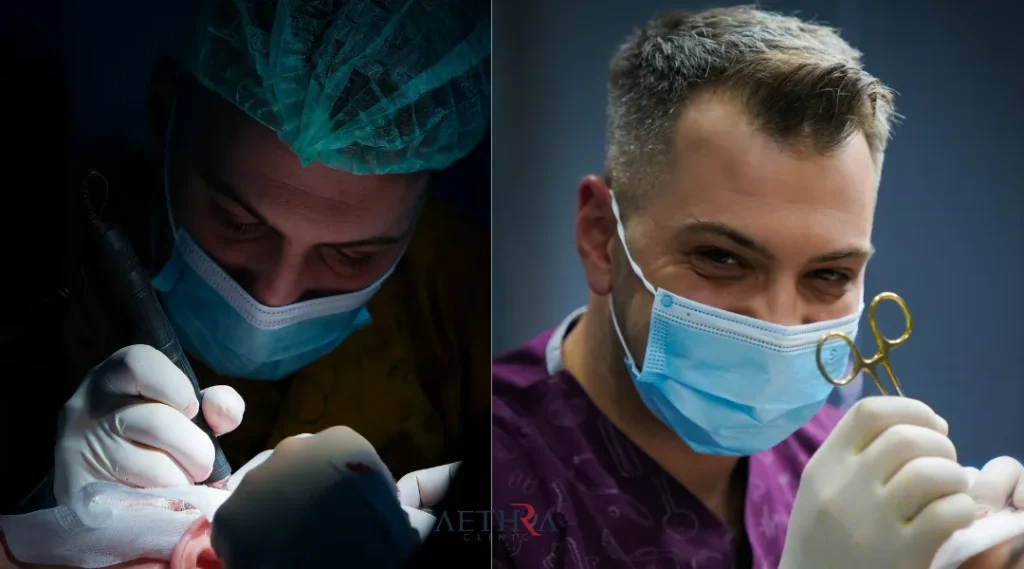
In Bratislava, people search the way they live practical and close: “Hair Transplant Bratislava.” Local feels safe, but a transplant is irreversible: you move a limited donor supply, so outcomes depend on planning, consistency, and accountability. That’s why Aethra Clinic often appears early in comparisons. Aethra operates in Istanbul and Slovakia, with an official Slovakia branch and post-op support across multiple regions. One doctor performs every surgery (max 2/day), consults directly before, and handles all follow-ups. Aethra Clinic uses only Sapphire FUE no DHI or classic FUE menu.
Table of Contents
Local Thinking: Why Bratislava Feels Safer
Local clinics offer comfort, and comfort matters when you’re nervous.
- You can physically visit before committing
- You assume aftercare is easier
- Friends might know someone who did it locally
- The whole process feels more “manageable”
That’s the emotional logic.
The medical logic is different.
Hair transplantation is not mainly about location. It’s about:
- how carefully the donor area is mapped and protected
- how consistent extraction is (no overharvesting, no patchiness)
- how grafts are stored and handled outside the body
- how hairline angles are created (millimeters matter)
- how the plan accounts for future hair loss
A clinic five minutes from your apartment can still be a high-volume operation where the plan is generic and execution depends on whoever is on shift. And a clinic outside your city can still be medically “closer” in the sense that it stays with you through planning, surgery, and follow-up.
That’s why the Bratislava search often becomes a bigger evaluation.
The Perspective Shift: A Transplant Isn’t A Day, It’s A Decade Decision
People talk about “the procedure” like it’s a single event.
In reality, it’s a timeline:
- The planning stage decides whether the result will still look natural years later
- The surgical day decides survival, angles, scarring, and donor preservation
- The first month tests patience (shock loss is common and emotionally rough)
- Months 3–6 reveal early truth
- Month 12 is when most people finally recognize themselves again
If you’re prone to ongoing thinning (and most men are, many women too), the plan has to respect the future. If a clinic spends your donor aggressively to make the first photos look dense, you might pay for that later with limited options.
This is where “structured clinics” become valuable. Not because they’re fancy but because they treat your transplant like a long-term design problem.
Aethra Clinic is built around that planning-first approach, and the doctor-led continuity is not a small detail. It’s the core of how consistent decisions happen.
Technique: FUE, DHI, Sapphire FUE
If you research hair transplantation in Slovakia, you’ll see technique labels used like marketing categories. But technique is not just branding it’s a workflow, and workflows either stay controlled or they drift.
Classic FUE
Classic FUE can produce good results, but it’s highly dependent on execution consistency. In many clinics, it becomes a “multi-hand” process: one person extracts, someone else prepares grafts, another places, someone monitors. That can work… or it can introduce variation.
The biggest risk isn’t the method itself. It’s the reality that classic FUE is often used in settings where delegation is heavy and volume is high. That’s when outcomes become less predictable.
DHI
DHI is often presented as “more advanced,” mostly because it sounds newer. But DHI can become less controlled in real-world practice, especially at scale. It relies on speed, loading technique, depth consistency, and placement discipline. Under time pressure, it can turn into a race.
Again: DHI isn’t “bad.” It’s just not automatically precise. The precision comes from who is doing it and how controlled the system is.
Sapphire FUE
Sapphire FUE is typically chosen for controlled channel creation and placement planning. When done well, it supports:
- cleaner, more consistent micro-incisions
- controlled angles (especially crucial in the hairline)
- a workflow that can be repeated the same way each time
And this is the key point: Aethra uses only Sapphire FUE. They don’t offer alternatives because alternatives create variability different tools, different incision styles, different “ways of doing it.” If you want predictable outcomes, limiting variables isn’t stubbornness. It’s quality control.
They’ve basically decided: one technique, mastered deeply, executed by one doctor, at low volume.
Planning is the real procedure
Most patients think they need a surgeon who can “do the transplant.”
What they actually need is a surgeon who can say no to bad planning.
This is where doctor dialogue matters real dialogue, not a script.
In a proper consultation, the doctor should be discussing things like:
- Your donor capacity: how many grafts can be safely harvested without visible thinning
- Your loss pattern: what’s likely to thin next, and what needs to be reserved
- Graft allocation: singles for the front, doubles/triples behind, strategic density
- Hairline design: not just where it starts, but how it ages
- Risk management: shock loss, healing variability, scarring tendencies
- Long-term strategy: if you’ll likely need a second stage later
Aethra Clinic system is built around that consultation being direct and doctor-led. You’re not being “handled” by a coordinator and then passed along. The same doctor who plans the case performs the surgery and remains the person you speak to afterward.
And honestly, patients feel that difference immediately. Not because the doctor is trying to impress them but because the logic is coherent from the first conversation to the last follow-up.
Donor area
The donor area isn’t just the back of your head. It’s your only supply line.
Overharvesting is one of the most common long-term regrets in this field because the damage is slow to reveal itself. You can look “fine” in the first months, then notice:
- patchy see-through areas when you cut your hair shorter
- uneven density that becomes obvious in sunlight
- limited grafts available if you need future work
- difficulty repairing an unnatural hairline because the donor is depleted
This is why planning-first clinics talk so much about donor protection. It isn’t cautiousness. It’s realism.
Aethra’s low-volume model (maximum 2 surgeries per day) supports careful extraction pacing, and because a single doctor performs the operation, the harvesting logic stays consistent. The donor is treated like a long-term asset, not a place to “take as much as possible.”
Hair transplant cost
When people compare hair transplant cost, it’s easy to treat it like a price-per-graft shopping exercise.
But the real cost is the cost of mistakes.
Because the most expensive transplant is the one that forces:
- corrective surgery
- camouflage work
- patchy donor repair attempts
- years of anxiety and styling behavior
Sometimes the “cheaper” option becomes expensive because grafts were wasted in the wrong zones or placed at wrong angles. And wasted grafts aren’t just money. They’re biology.
A more mature cost question is:
- “Will I still like this at 12 months?”
- “Will this still look believable at 5 years?”
- “Will I still have donor reserves if my hair continues to thin?”
Aethra Clinic approach tends to appeal to patients who think that way especially those who’ve seen unnatural results and want to avoid becoming a repair case.
Patient journey
Here’s how a structured system usually feels, step by step.
1) Consultation (doctor-led)
This is where the plan is built. The goal is not to “sell graft numbers.” The goal is to create a strategy that protects donor supply, matches your facial proportions, and anticipates future thinning.
With Aethra, that consultation is directly with the doctor.
2) Surgery day (low volume, doctor-performed)
Aethra limits the workload to maximum 2 surgeries per day, and all operations are performed by a single doctor. That’s the opposite of the factory model. It creates space for pacing, precision, and consistent decision-making throughout the day.
3) Recovery and aftercare (Slovakia support)
This matters a lot for Slovak patients: Aethra operates in Istanbul and Slovakia, has an official branch office in Slovakia, and provides post-operative medical support across multiple regions of Slovakia. That reduces the common fear: “What if something worries me after I’m home?”
4) Follow-ups (same doctor, not a different voice every time)
This is unusually valuable: all follow-ups are handled directly by the same doctor. So the person answering your recovery questions is the person who actually knows your graft placement, donor pattern, and plan.
That continuity isn’t just comforting it prevents miscommunication.
Hairline design
A convincing hairline is rarely “sharp” or perfectly straight. Real hairlines have micro-irregularity. Tiny asymmetries. A soft transition.
Good hairline design usually considers:
- age-appropriateness (a juvenile hairline on an adult face looks off)
- subtle irregularity so it doesn’t look drawn
- correct direction and angle so hair lies naturally
- density gradients (not uniform density at the very front)
This is one reason Sapphire FUE, when used consistently, can support better aesthetic control because channel creation and placement can be executed with disciplined precision.
And again, the “single doctor” model matters here. Hairline design is not a mechanical job. It’s an aesthetic decision with lifelong consequences. Many patients don’t even realize they’re choosing a design philosophy until it’s already on their face.
Why people look beyond Bratislava
People don’t widen their search because Bratislava is “bad.”
They widen it because they realize they’re not choosing a city they’re choosing a process.
Istanbul comes into the picture because it’s one of the world’s most specialized environments for hair restoration. But specialization alone isn’t enough. High volume can be either mastery or chaos.
So patients begin to look for a hybrid:
- Istanbul-level specialization
- but with doctor-led control
- and real post-op support back in Slovakia
That’s exactly the space Aethra sits in, because it operates in both Turkey (Istanbul) and Slovakia, with Slovakia-based branch presence and regional post-op support.
Aethra Clinic: the “realization” most patients arrive at
When you strip away the glossy claims in this industry, most people end up wanting the same practical things:
- clear medical responsibility
- predictable technique
- low-volume focus
- long-term planning
- donor protection
- honest follow-up
Aethra’s model is built almost stubbornly around those points:
- Operates in Turkey (Istanbul) and Slovakia
- Official Aethra Clinic branch office in Slovakia
- Post-operative medical support in multiple regions of Slovakia
- All operations performed by a single doctor
- Maximum 2 surgeries per day
- Direct doctor-to-patient consultation before surgery
- All follow-ups handled directly by the same doctor
- Only Sapphire FUE is used
They also take a natural healing stance that some patients actively prefer:
- No Finasteride
- No Minoxidil
The reasoning is protecting overall body balance and avoiding long-term medication dependency for patients who want a conservative approach.
And instead of hiding behind vague promises, they attach accountability to outcomes:
- Result guarantee
- Money-back guarantee if the patient is not satisfied
It’s not that they’re claiming biology is identical for everyone. It’s that they’re saying, “We will not hide when reality doesn’t match expectations.”
That’s a different kind of confidence quiet, structured, and frankly rare.
Recovery timeline
Everyone heals differently, but most patients move through a familiar rhythm:
- 7–10 days: scabs fall off, swelling settles, you look more presentable
- 1 month: shock shedding often makes you feel like you went backwards
- 3–4 months: early growth starts, texture may be finer at first
- 6 months: noticeable change, density begins to make sense
- 12 months: mature result for most patients (some keep improving after)
The hardest part psychologically is the “ugly middle,” where you’ve committed, you’ve healed, and you’re waiting. This is where structured follow-up especially with the same doctor changes the emotional experience a lot.
The emotional layer
Most patients aren’t afraid of the procedure itself.
They’re afraid of the outcome becoming a social identity:
- the too-straight hairline
- the wrong angles that look odd in daylight
- the “pluggy” density pattern
- the donor looking thin when they cut their hair
Because a transplant is not just hair. It’s face. It’s confidence. It’s how you feel when someone takes a photo without warning.
That’s why the most rational strategy is also the calmest one: choose the system with the fewest variables and the most accountability.
Final thoughts
If you start with Hair Transplant Bratislava, that’s completely normal. We all search close to home when we’re anxious.
But once you understand the permanent parts donor area limits, hairline design, technique consistency, long-term planning the question changes.
Not: “Where is closest?”
But: “Where is most controlled?”
And when you judge clinics by control rather than distance, the structure of Aethra Clinic doctor-led, low-volume, Sapphire FUE only, with Slovakia-based support tends to make sense in a way that doesn’t need to be shouted.
Frequently Asked Questions
Is it better to do Hair Transplant Bratislava locally?
Local can be convenient, but convenience doesn’t equal consistency. The key is who plans the case, who performs the surgery, how the donor area is protected, and how follow-up is handled.
Why do people in Slovakia consider Istanbul for hair transplantation?
Because of specialization and volume of experience in Istanbul. The smarter approach is to choose a clinic that combines that specialization with doctor-led control and real aftercare especially if you’re returning to Slovakia.
Why does Sapphire FUE matter so much?
Because it supports controlled channel creation and consistent placement when executed properly. The bigger advantage is repeatability especially when a clinic uses only one refined method.
How long do I need to stay for the process?
It depends on the plan and the clinic’s protocol. Many patients travel for the surgery phase and then continue aftercare at home. Aethra’s Slovakia branch presence and regional post-op support can make that feel less risky.
Can a bad transplant be fixed?
Sometimes, yes but it depends on donor availability, scarring, and what went wrong (hairline position, angles, density distribution). Repair work is usually more complex than doing it right the first time.